

Graphic Recording for Indigenous Communities

Updated: Aug 16
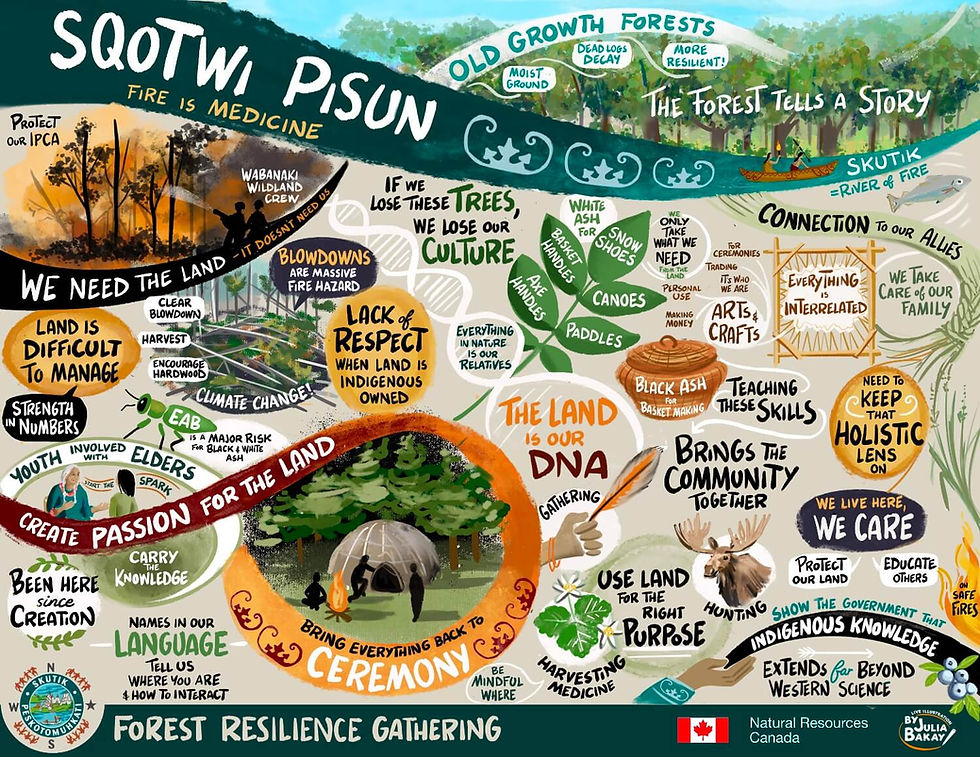
My experience with Graphic Recording for Indigenous Gatherings
Some of the most meaningful events I've had the privilege of illustrating have been gatherings led by and for Indigenous communities. Whether the conversations centre around stewardship, language revitalization, health, education, governance, or economic development, there's something unique about witnessing wisdom and knowledge being shared through stories and experience.
Graphic recording has a way of honouring those conversations.
Rather than producing pages of meeting notes that are rarely revisited, it creates a graphic record that captures the ideas, reveals the connections between them, and becomes a lasting reminder of the event and the conversations that shaped it.

Why Julia Bakay for Graphic Recording Indigenous Events
I bring relevant academic, artistic, and practical experience to my work with Indigenous communities. I studied American Studies at university, with a strong focus on Indigenous nations, their histories, cultures, political realities, and contemporary experiences. My background in art history has also made me familiar with Indigenous visual traditions and forms, including wampum, basketry, beadwork, regalia, and other forms of material and symbolic expression.
Over the years, I have had the opportunity to work directly with several Indigenous communities, which has taught me a great deal about how to approach this work with respect and care. Most importantly, I am there to listen. My role is not to come up with interpretations, speak for anyone, or impose my own ideas, but to carefully capture what people choose to share. The knowledge and experience I bring helps me understand the context, but the content comes from the voices in the room. My job is to make the words visible, so they can continue to live on beyond the gathering.
Why Graphic Recording works so well at Indigenous Gatherings
Many Indigenous cultures have rich oral storytelling traditions. Stories carry wisdom, knowledge, history, and values across generations, and they continue to play an important role in community gatherings today.
That's one of the reasons graphic recording feels like such a natural fit.

Rather than reducing a conversation like this to a list of action items, graphic recording preserves the flow of the discussion. It captures stories, ideas, and helps people see how different perspectives connect. The finished visual becomes a shared memory of what happened in the room.
Many of the Indigenous gatherings I've illustrated have been highly conversational. Elders, Knowledge Keepers, youth, community leaders, researchers, and government representatives all bring different experiences to the discussion. Rather than speaking in short presentations, people often share personal stories, examples from their communities, and lessons learned over many years.
Another thing I've noticed is that Indigenous gatherings are often designed around dialogue rather than simply information sharing. People are there to listen, reflect, and learn from one another. A live visual helps participants follow those connections as they emerge, making it easier to see recurring themes across different speakers.
It's also worth remembering that visuals have long been part of many Indigenous cultures, although they look different from one Nation to another. Pictographs, carvings, woven patterns, beadwork (as seen in the graphic record of the Women in Wampum gathering below), maps, and other visual forms have all been used to communicate stories, place-based knowledge, and cultural teachings. Graphic recording doesn't replace those traditions, but it does share something in common: using images to help people remember, understand, and revisit important conversations.

If you’d like to learn more about graphic recording, I invite you to keep reading or get in touch. I’d be happy to chat about how visual storytelling could support your next conference, gathering, or community conversation.


